
When comparing carry-on vs checked bag, most people first think about size limits and airline baggage rules. But the difference is not only about whether a bag is small enough to fit in the cabin.
In this guide, we’ll compare carry-on vs checked bag from both a traveler’s and a bag manufacturer’s perspective, covering airline restrictions, packing considerations, bag types, durability, and how to choose the right option for different trips.
Carry On vs Checked Bag: What Are the Key Differences?
The difference between carry-on and checked baggage is mainly about how the luggage moves through the journey. Carry-on baggage remains with the passenger, while checked baggage is transferred to the airline and transported in the cargo hold.
1. Size, Weight, and Capacity
Carry-on baggage must meet the airline’s cabin limits, so both external dimensions and weight are usually more restricted. Checked baggage generally allows more packing space and is better suited to heavier or bulkier loads.
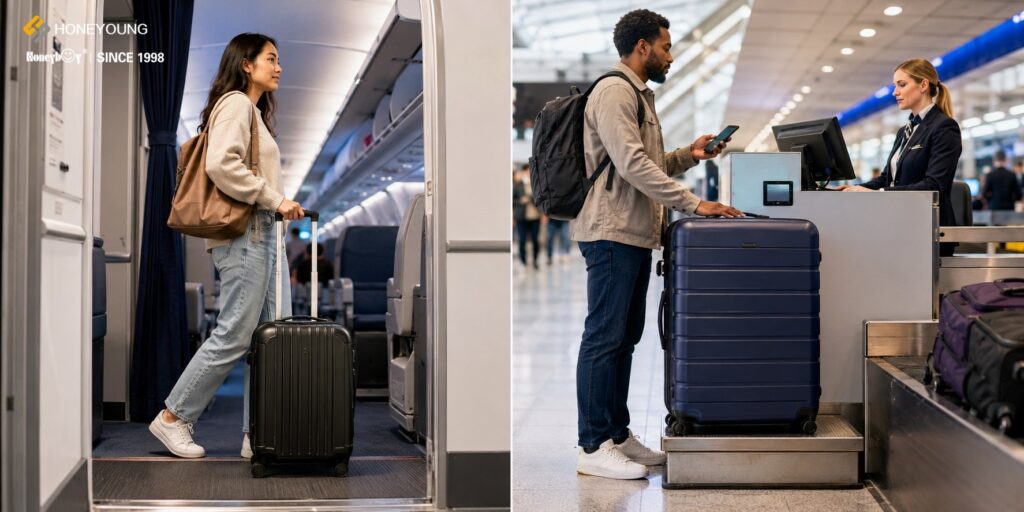
- There is no single global standard. Limits can vary by airline, route, fare type, and aircraft, so travelers should always check the applicable baggage policy before departure.
2. Access During the Journey
Carry-on baggage is better for items that may be needed before or during the flight, such as documents, electronics, chargers, medication, or a change of clothes.
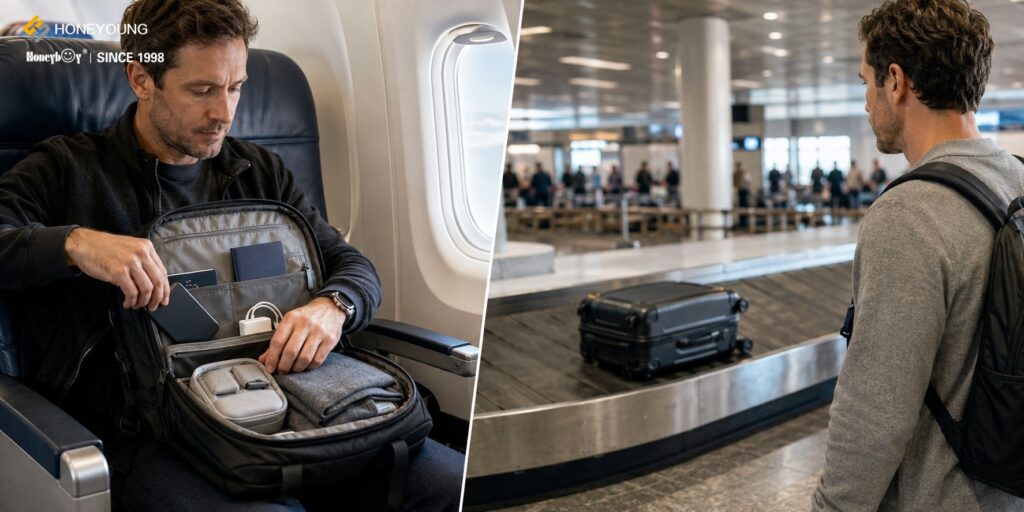
Checked baggage normally cannot be accessed again after check-in until it reaches baggage claim, so items needed during the journey should not be packed there.
3. Handling Conditions
Carry-on baggage is mainly moved by the traveler. Checked baggage, by contrast, passes through conveyor systems, sorting areas, loading, unloading, and baggage claim.
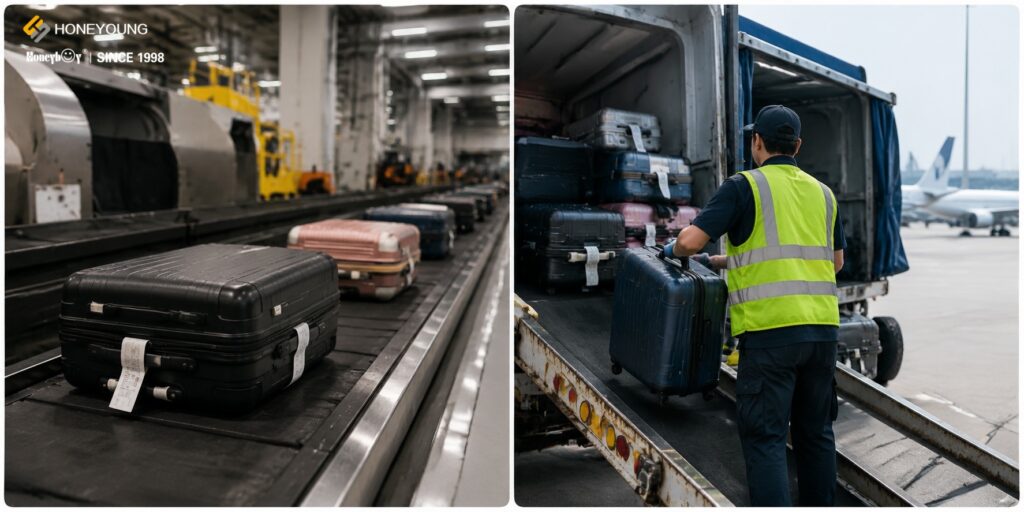
This is an important difference.
- Checked baggage is usually exposed to more uncontrolled handling, which can increase abrasion, impact, compression, and stress on handles, zippers, wheels, and reinforced areas.
4. Time, Convenience, and Fees
Carry-on baggage can make the airport process faster because travelers can often go directly to security and leave the airport without waiting at baggage claim.
Checked baggage provides more capacity, but may involve extra check-in time, baggage collection, and additional fees depending on the airline and fare.
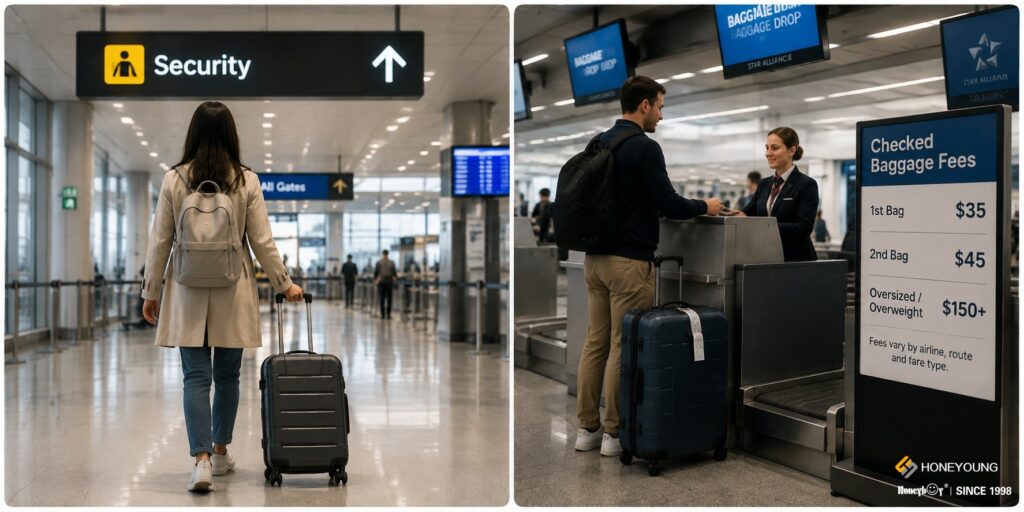
Here’s a quick comparison to make the differences easier to see.
| Factor | Carry-On | Checked Bag |
| Size & Weight | More restricted by cabin limits | Usually allows larger and heavier luggage |
| Capacity | Better for lighter packing | Better for larger packing volumes |
| Access | Available during most of the journey | Unavailable after check-in |
| Handling | Mostly handled by the traveler | Handled through airport baggage systems |
| Airport Time | Usually faster | Requires check-in and baggage claim |
| Fees | Depends on airline and fare | Additional fees are common |
| Handling Risk | Lower exposure | Greater exposure to impact, abrasion, and compression |
Airline Rules for Carry-On and Checked Bags
Airline baggage rules are one of the main factors that determine whether a bag can stay in the cabin or needs to be checked. Airlines usually focus on the bag’s external dimensions, total weight, and the baggage allowance included with the ticket.
1. Size and Weight Limits
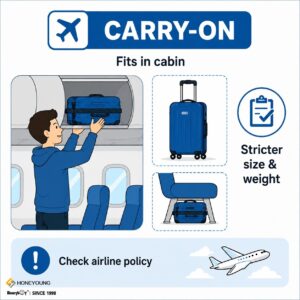
Carry-on baggage must fit within the available cabin space, usually in the overhead compartment or under the seat.
For this reason, airlines generally apply stricter size and weight limits.
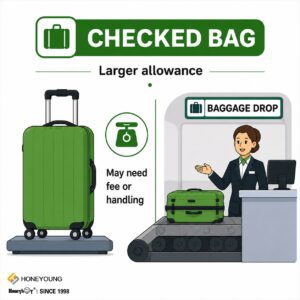
Checked baggage can usually be larger and heavier, but it still needs to stay within the airline’s maximum allowance.
Oversized or overweight luggage may require an additional fee or special handling.
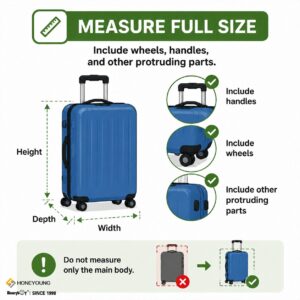
When measuring a bag, travelers should consider the full external dimensions, including wheels, handles, and other protruding parts, rather than only the main body.
2. Baggage Allowances and Fees
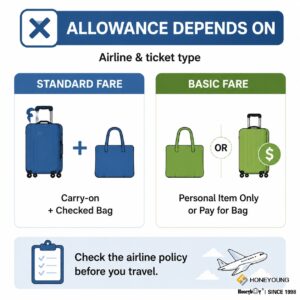
Baggage allowance depends on the airline and ticket type.
Some fares include both carry-on and checked baggage, while others may include only a personal item or charge separately for additional luggage.
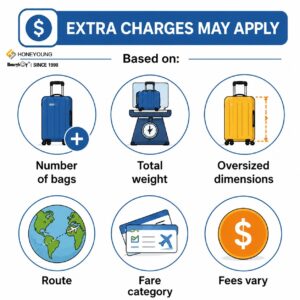
Extra charges may apply depending on the number of bags, total weight, oversized dimensions, route, and fare category.
These fees can vary significantly between airlines, so travelers should check the applicable baggage charges before departure.
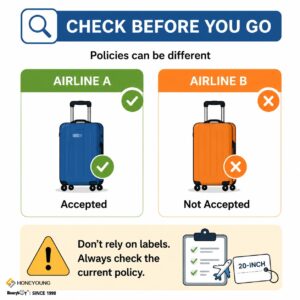
Travelers should check the airline’s current baggage policy before departure.
Don’t rely only on labels such as “20-inch carry-on,” since a bag accepted by one airline may not be accepted by another.
3. Real-World Airline Examples
There is no universal standard for carry-on and checked baggage. The examples below show how baggage allowances can vary among major international airlines.
| Airline | Carry-On Example | Checked Baggage Example |
| Emirates | Economy: 1 piece, up to 7 kg, max. 55 × 38 × 22 cm | Allowance varies by route, fare, and travel class |
| Qatar Airways | Economy: generally 1 piece, up to 7 k | Checked allowance varies by fare and route; both piece and weight concepts may apply |
| Singapore Airlines | Allowance varies by cabin class | Checked allowance varies by route and class |
| Lufthansa | Economy: generally 1 carry-on up to 8 kg, max. 55 × 40 × 23 cm, plus a personal item | Free checked allowance depends on fare and travel class |
| British Airways | 1 cabin bag up to 56 × 45 × 25 cm plus a smaller handbag/backpack | Checked allowance varies by fare and cabin |
| ANA | 1 carry-on plus 1 personal item; restrictions may vary with aircraft | Checked allowance depends on route and cabin class |
| Cathay Pacific | Economy: generally 1 cabin bag up to 7 kg plus a small personal item | Economy checked allowance varies by fare; some fares include 1 piece, others 2 pieces |
| Delta Air Lines | 1 carry-on plus 1 personal item; carry-on max. 56 × 35 × 23 cm | Checked baggage allowance and fees depend on fare and route |
| American Airlines | 1 carry-on plus 1 personal item; carry-on max. 56 × 36 × 23 cm | Checked allowance and fees vary by destination, fare, and status |
| Air Canada | Standard carry-on max. 23 × 40 × 55 cm plus a personal item | Checked allowance varies by fare, route, and loyalty status |
- These examples are for reference only. Baggage allowances can change by fare, route, cabin class, aircraft, and operating carrier, so always check the airline’s current policy before departure.
What Should You Pack in Carry-On vs Checked Luggage?
What goes into a carry-on and what goes into checked luggage should be decided mainly by access, value, safety, and airline restrictions. Items you may need during the journey should stay close to you, while bulkier or less frequently used items can usually go into checked baggage.
What Is Better Kept in Your Carry-On?
Carry-on luggage is the better place for items that are important, valuable, fragile, or difficult to replace during the trip.
Typical examples include:
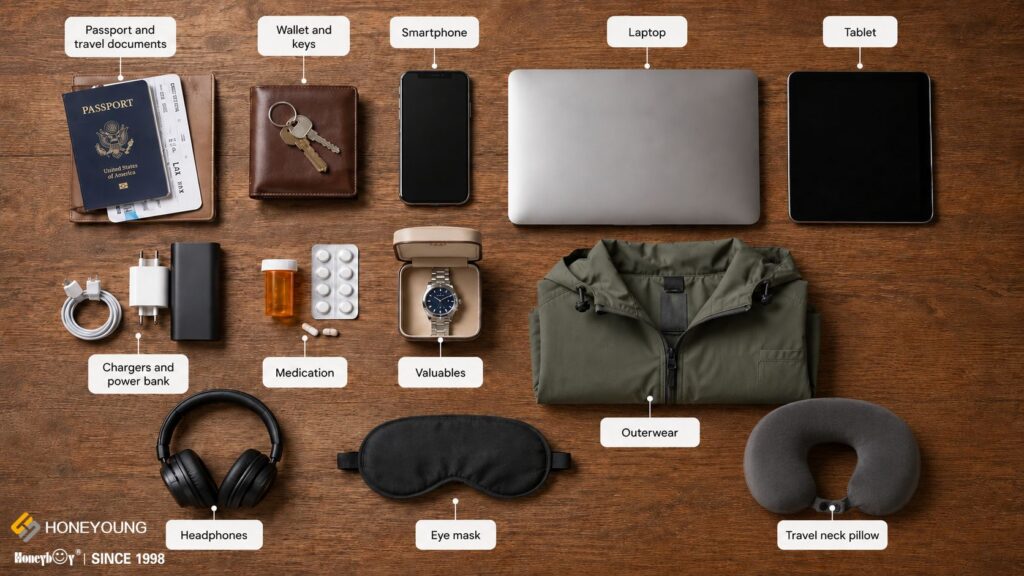
Keeping these items with you also reduces the inconvenience if checked baggage is delayed.
What Is Better Packed in Checked Luggage?
Checked baggage is more suitable for items that take up more space or are not needed during the flight.
This may include:

Packing heavier items closer to the center of the bag can also help improve stability and reduce unnecessary pressure on one side of the luggage.
What Cannot or Should Not Be Packed?
Some items are restricted because of aviation safety rules, and the requirements for carry-on and checked baggage are not always the same.
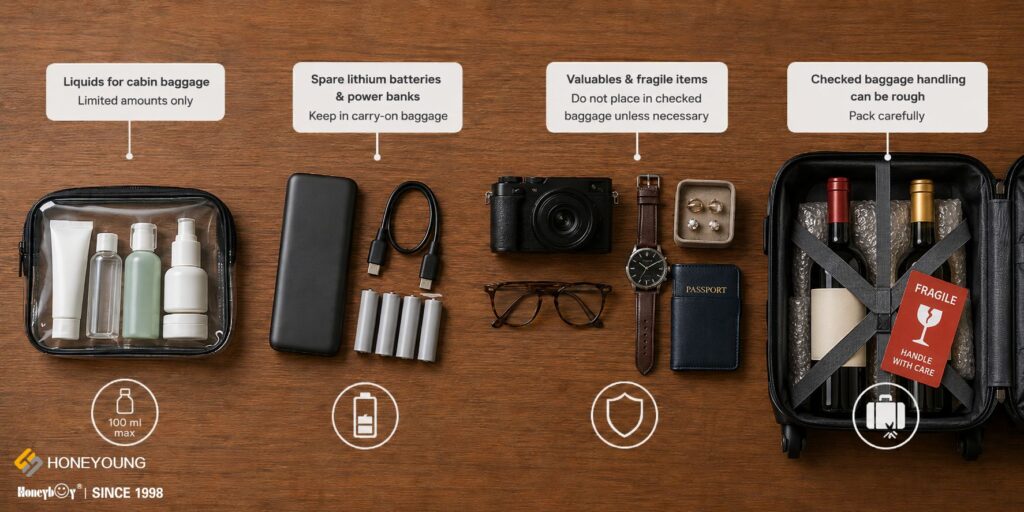
- Rules can vary by country, airline, and item type, so travelers should check the latest airline and airport regulations before departure.
Packing Tips for Space and Weight
Efficient packing is not just about fitting more into the bag; balanced weight distribution also helps reduce stress on the structure.
For checked luggage, overfilling can increase internal pressure on zippers, seams, handles, shell panels, and expansion sections.


Does Bag Type Matter?
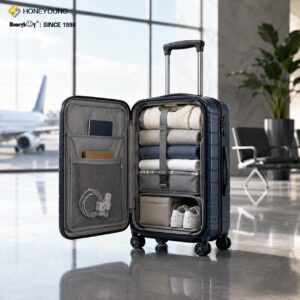
Yes. Although a suitcase, backpack, or duffel can all be used as carry-on or checked baggage, their structure and carrying style make them better suited to different travel situations.
Suitcases
Suitcases offer a structured shape, organized packing space, and better protection for belongings.
Wheeled models are especially convenient in airports and other smooth environments.

Backpacks
Backpacks provide better mobility and keep both hands free, making them practical for stairs, public transport, walking, and frequent transfers.
Their flexible backpack size and soft construction also make them easier to squeeze into limited spaces.

Duffel Bags
Duffel bags provide flexible storage and are convenient for clothing, sports gear, and bulky or irregularly shaped items.
However, their soft structure generally provides less protection than a suitcase.
| Comparison | Suitcase | Backpack | Duffel Bag |
| Main Advantages | Structured packing, good protection, easy to roll | Hands-free, flexible, easy to carry | Lightweight, flexible capacity, good for bulky items |
| Main Limitations | Less convenient on stairs or uneven surfaces | Less rigid protection, limited capacity in smaller sizes | Less structural protection, less comfortable with heavy loads |
| Carry-On Suitability | ★★★★☆ | ★★★★★ | ★★★★☆ |
| Checked Baggage Suitability | ★★★★★ | ★★☆☆☆ | ★★★☆☆ |
At Honeyoung, we believe the key is not whether a suitcase, backpack, or duffel is better.

How to Decide Whether to Carry On or Check a Bag
There is no single better choice between carry-on and checked baggage. The right option depends on how long you are traveling, what you need to bring, how often you will move between places, and how much convenience or capacity matters to you.
1. Trip Length and Packing Volume
Short trips often require less luggage, making carry-on a practical choice.
As the trip gets longer, the need for extra clothing and personal items usually increases, so checked baggage may offer more useful space.

2. What You Need to Carry
What you pack is just as important as trip length. Carry-on works well for compact essentials, while checked baggage is better for bulky items or larger quantities.
Always check restrictions, since some items are limited to either cabin or checked baggage.

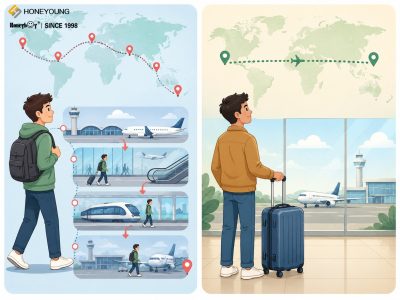
3. Travel Route and Transfers
Carry-on is often more convenient for trips with multiple connections or frequent transfers, while checked baggage can work well for direct trips when extra capacity matters more.
4. Mobility and Convenience
Consider how you’ll move during the trip.
A smaller, lighter bag is easier for walking, stairs, and public transport, while a larger checked bag is less of an issue when using taxis or staying in one place.
Backpacks suit uneven routes, while wheeled suitcases work better on smooth surfaces.

5. Protection and Durability Needs
Fragile or valuable items are usually better kept in carry-on luggage when allowed.
Checked baggage faces more handling, so durability and secure construction matter more.

Still unsure?
Ask yourself three questions:
- Can I fit everything in a cabin-sized bag?
- Will I be moving frequently between locations?
- Do I have fragile or valuable items I can’t risk losing?
If most answers are yes, go carry-on. If you need more space, fewer transfers, and don’t mind waiting at baggage claim, checked baggage is the smarter pick.
FAQ
Can an Airline Ask You to Gate-Check Your Carry-On?
Yes. Even if your bag meets the airline’s carry-on size and weight limits, staff may still ask you to check it at the gate.
This usually happens when overhead bin space is limited, the aircraft is smaller, or the flight is very full. In that case, the bag is tagged at the gate and transported with checked luggage.
Is a Personal Item the Same as a Carry-On Bag?
No. A personal item is usually smaller than a carry-on and is expected to fit under the seat in front of you.
Common examples include a small backpack, handbag, briefcase, or laptop bag.
A carry-on is generally larger and stored in the overhead compartment, but the exact size and allowance depend on the airline and fare.
Do Checked Bags Transfer Automatically on Connecting Flights?
Often yes, especially when all flights are booked on the same ticket and the airline handles the baggage through to the final destination.
However, this is not guaranteed. Separate tickets, some international connections, and customs procedures may require passengers to collect their bags and check them in again.
What Happens If Checked Baggage Is Delayed or Lost?
If your checked baggage does not arrive, report it to the airline’s baggage service desk as soon as possible and keep your baggage receipt and claim reference.
Airlines may arrange delivery once the bag is found and may reimburse reasonable essential purchases during a delay.
Compensation rules vary depending on the airline, route, and applicable regulations.
Should You Lock Checked Baggage?
A lock can help prevent accidental opening and provide a basic level of security, especially on soft-sided or zipper luggage.
However, it cannot fully protect against theft or inspection.
Where security authorities may need to open baggage, travelers should use an approved lock or follow the local airport security requirements.
Can You Check an Empty or Partially Filled Suitcase?
Yes. Airlines generally allow empty or lightly packed suitcases as long as they meet the applicable baggage rules.
However, a partially filled bag should be packed carefully because loose items can move around during handling.
Using compression straps, dividers, or soft filler can help keep the contents stable.
Does Travel Insurance Cover Carry-On and Checked Baggage Differently?
It can. Some travel insurance policies apply different limits or exclusions depending on whether the baggage was carried by the traveler or checked with the airline.
Valuable items such as electronics, jewelry, or cash may have lower coverage limits when placed in checked baggage, so it is important to review the policy details before traveling.
Can Airlines Change a Carry-On to Checked Baggage at the Gate?
Yes. Airlines may require a carry-on to be checked at the gate if it is too large or heavy, or if there is not enough cabin storage space.
The bag may then travel in the aircraft hold and be returned either at baggage claim or, on some flights, near the aircraft after landing.
Whether a fee applies depends on the reason for gate-checking and the airline’s policy.